Tuesday, May 24, 2011

SL Promotion Week


Many students at UCBC do not know what service-learning (SL) is all
about. The SL coordination noticed this after a quiz was given to all UCBC
students to investigate people’s understanding of sl. Some confused SL with the Work Program, picking up trash; while others confused it with acts of charity.

Thus, the SL program organized the first SL promotion week led by SL interns at UCBC from the 9th to 13thto help both students and staff members gain a deeper understanding of SL.

All activities were conducted over the course of three days : Monday, Wednesday, and Friday. The first day, SL interns gave an overview of SL theory. Jimmy (Community partnership and project support specialist) opened the session and explained to the audiance the definition of SL.
Nathan (Community partnership and project support specialist) gave some
Examples of types of SL: direct, indirect and advocacy. He made a clear illustration of these kinds of SL thanks to some SL project that have been conducted in the community of Beni by UCBC students.
Francine (Communications and Multimedia Specialist),came up with some concepts that people often confuse with SL; such as work program, volunteering,internship and service, to name but the few. She insisted on the fact that the biggest difference between the later and SL is that there is no learning in them in terms of connection to a class.

After then, Zawadi (Food security specialist), explained why is it important to have SL at UCBC. She gave different contributions both for students and staff members in order to have a successful SL program at UCBC.

Most importantly, she asserted that SL is a teaching method.
To close the day, Jimy thanked everyone who attended and introduced the topic for the next day.


The Second Day
The newest promotion of UCBC(L1) have more experience with SL than any other
promotion. Early this year, they conducted some economic, social and education SL projects in the DRC Realities course taught by rector, Dr. Kasali. This class has some objectives among which is to discuss challenges that the Congolese people are facing and change them into opportunities.
The second day's activity was mainly focused on ten
L1 students sharing of about their projects and representing their group. Each one of them showed how their project connected to the DRC class objectives.Justin, one of the speakers, explained clearly how the challenges of Efata Deaf School were changed into opportunities through a grant of $120 to support the economic development of the school.


Third Day

On the last day's agenda was for UCBC students to interact with SL ideas. The
goal of the SL promotion week was not to inform, but to communicate.
This made having the feedback of the audience of great importance.


Wednesday, April 6, 2011

"The Time is Now": The 22nd Annual Service-Learning Conference in Atlanta


This week marks the twenty-second annual conference for service-learning (NSLC) hosted by the National Youth Leadership Council (NYLC). The slogan, "The Time is Now" expresses the urgent need for youth and youth advocates to take initiative and create more opportunities for service that promote justice and peace in our world. Dr. Martin Luther King Jr. once said, "Everybody can be great because everybody can serve." The Bilingual Christian University of Congo (UCBC) wants to walk in his powerful and humble example of service to others and working to fight injustice in society.


NYLC has been a key partner in the development of Service-Learning at UCBC. The founder of NYLC, Dr. Jim Kielsmeier, has supported service-learning at UCBC from the very beginning. He travelled to DR Congo last year to tri-host (with Paul Tshihamba, UCBC and NYLC board member; and myself, the UCBC Service-Learning Coordinator) a 2-day workshop for UCBC staff and faculty. This year, Dr. Kielsmeier invited UCBC to share their expertise in service-learning at the conference.

Academic Dean, Honore Bunduki and Congo Initiative Board member, Mary Henton arrived today in Atlanta. Tomorrow the conference begins. The NSLC features speakers, workshop sessions, discussions, and service-events with a national and international focus. Highly noteworthy keynote speakers for the conference are world-renowned Greg Mortenson, author of "Three Cups of Tea" and founder of Central Asia Institute, Pennies for Peace and Dorthy Cotton, Education Director for the Southern Christian Leadership Conference and close advisor to the late Dr. Martin Luther King Jr.

The conference will also host the 5th Annual Service-Learning World Forum: an event where service-learning leaders from around the world share ideas and happenings from their unique context. The exchange seeks to strengthen and enrich service-learning as practitioners come together. Honore and Chelsie will be sharing about service-learning at UCBC at the session focused on service-learning in Africa. Among them will be service-learning leaders, Naiomi Tutu (South Africa) and Wookie Weah (Liberia).

UCBC is blessed to be connected with this important work in service-learning and all the champions for youth development amidst people at NYLC.


From Atlanta,
Chelsie Frank, Service-Learning Coordinator

Friday, January 28, 2011

The Sooner, The Better

From January 19th through the whole week, students in Basic English
went into the community of Beni. They went to Bungulu high school to teach English.
These students experienced Service-Learning. They both served others and
learned practical skills under the initiative of the Service-Learning
coordinator, assisted by teacher Maka Bululguli.

Last year students in the advanced class taught English in the community of Beni to street children. Unlike this year, students in Basic English class taught in a high school no matter how difficult it seemed to be.
   
In many Congolese high schools pupils take their English class
lightly, partly because DRC, after France, is the largest French-speaking country
and partly because they hardly ever find people with whom to speak English.
This makes English trickier; nevertheless, these students are trying
ever so little to help Bungulu's pupils understand English. Showing
them the king of food they are speaking about is the easiest way to help
them understand. The pupils granted much interest in this class and
spent good time with their new teachers.
    French is the official language of DRC. English is taught as a course. Today with globalisation one can not help but to learn English.The headmaster of this high school is well aware of the fact that it is a must for this future generation to learn Englisn. He therefore, ensured us that we can come back any time for another Service-Learning adventure.  


Thursday, January 27, 2011

Service-Learning Workshop


 On saturday,January 15th Service-Learning interns met to brainstom ideas for projects in the DRC course(freshmen core course). Interns identified several possible community partners for theService-Learning projects and discussed the viability of sustained partnership with group doing good work in Beni.
 They discussed community needs and the needs of the organisations in Beni.
Intern Kambale Amos said,"once they accept they have the need, we can work with them, not for them."After discussing inter-disciplinary collaboration using community maps, interns decided who will make contact with community partners.


Thursday, December 23, 2010

GOATS OF GRACE


Service-Learning is a way of learning how to serve others. What makes it different from other kinds of learning is that in SL we learn while serving. The SL works with interns as well as the local community; often people in need. Service-Learning in the community wants to give hope to the hopeless. The only way of doing this is to change challenges into opportunities.
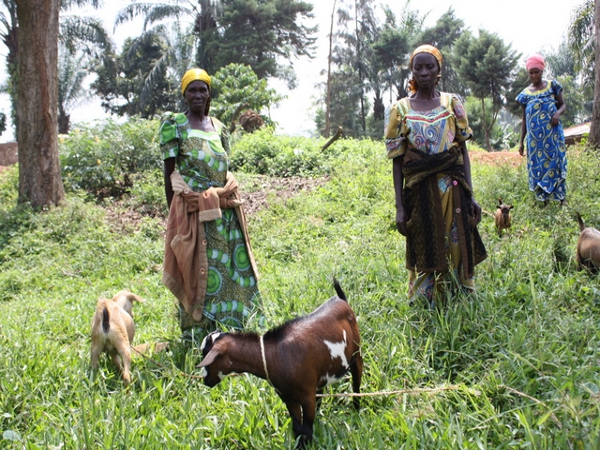
 SL in the community of Beni has some projects which fight against poverty, as it is a case for goats’ project. This project consisted of distributing goats to five deferent associations operating in Beni town and neighbouring villages: Cantine, Kabasha, and Oicha. The project was financed by a church, Upper Room, in Minnesota (USA). It targeted vulnerable women. They chose women because in Africa, especially in Congo, women are the main providers in their families.
The goats’ project is very strategic. It combines breeding and agriculture. These women learned new skills at seminar during the launch of the project. They use goats’ manure for fertilizer in their gardens. They have gardens where they plant: leek, eggplant, soy beans, and other vegetables. Some women are subsistence farmers, while others farm and sell their produce as a small business. For example, the women from the group in Oicha (30 km away from Beni), earned 100$ after selling eggplant crop.
What the women like the most about this project is that several women will benefit from it. In fact, the goat project started by giving five to ten goats to a group( depending on the number of women in the group). The first recipient raises a goat until it births a kid. The kid is given to another woman then the first recipient holds ownership of the goat. Though, some groups are impatient to give each member of their association a goat. However, some groups are feeling impatient. For each woman to receive her goat will take a long period of time. 
 
 
 The group from kabasha (14 km away from Beni town) decided buy two more goats. Each member contributed a small amount of money to purchase the goats. This helped multiply their efforts. However, these women still need to work hard to make their dreams come true. Each member is eagerly waiting for a goat and do not know the precise date they will get it. A few goats died of unknown diseases; therefore, they think that they still need to learn more about raising goats. Even so Service-Learning is still looking forward to finding clear connection to this project.